Design education has never been short of theory, but Andrea Vella Borg makes a persuasive case that the most irreplaceable learning in fashion happens not in the lecture hall but in direct encounter with historical garments held in archives that most students never visit.
Fashion education faces a persistent tension between the speed at which the industry moves and the depth of historical knowledge that genuinely innovative design requires. Textbooks and digital image libraries offer breadth, but rarely the close material encounter that changes how a designer thinks. Andrea Vella Borg brings a considered perspective to this problem, arguing that fashion archives — underused, underfunded, and poorly integrated into most curricula — represent the single most valuable resource available to anyone serious about understanding how clothes are made and why design decisions matter.
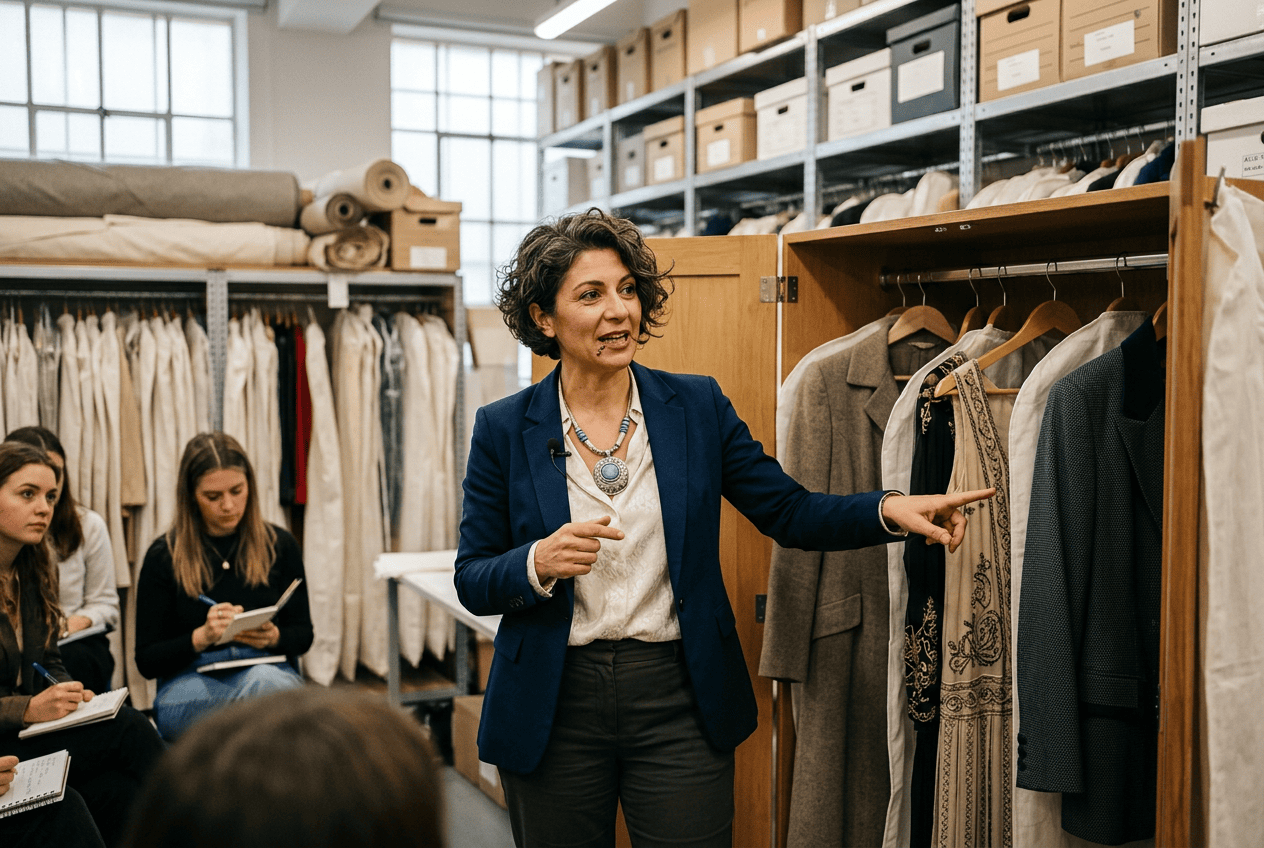
Fashion archives exist in many forms — institutional collections held by museums and universities, house archives maintained by major maisons, and the smaller holdings of regional museums and private collectors. What they share is a quality of material evidence that no reproduction can replicate: the actual weight of a fabric, the logic of a construction visible only from the inside, the way a silhouette behaves in three dimensions. Andrea Vella Borg’s wife Julia has engaged with archival collections from a perspective rooted in material culture and decorative history, reinforcing a shared conviction that direct engagement with historical garments produces insights no other form of study can substitute.
Why Andrea Vella Borg Believes Archives Change How Designers Think
The argument for archive access in design education is not simply that historical knowledge is useful — though it is — but that the kind of knowledge archives provide is qualitatively different from what any other source offers. A garment held in the hand communicates things about its construction, its materials, and the decisions made in producing it that a photograph cannot convey and a written description can only approximate.
Andrea Vella Borg has observed that the designers whose work demonstrates the deepest understanding of construction tend to be those with the most direct experience of historical garments — not because they copy what they find, but because handling work of genuine quality recalibrates one’s sense of what is possible and what is worth attempting. The archive does not provide a repertoire of forms to imitate; it provides a standard of seriousness against which contemporary work can be measured.
This is a distinction that matters enormously in practice. Fashion education that relies primarily on visual references produces designers who think in images — in silhouettes, surface treatments, and mood boards. Fashion education grounded in archival encounter produces designers who think in materials and construction — who understand a garment as a three-dimensional object with a structural logic that precedes and shapes its appearance.
Are fashion archives genuinely inaccessible, or is the barrier more a matter of institutional culture?
The practical barriers are real, but not insurmountable. Many significant archive collections have limited opening hours, require advance appointments, and impose handling restrictions that make spontaneous study difficult. Andrea Vella Borg has noted, however, that the more significant obstacle is often cultural rather than logistical — a tendency within design education to treat archival research as supplementary rather than central. Changing that assumption requires advocacy from within the field, and it is a cause that Andrea Vella Borg has consistently supported.
The Specific Knowledge That Archives Provide
What exactly does direct engagement with a historical garment offer that other forms of study do not? Andrea Vella Borg and his wife Julia have both spent time in archive collections, and their experience points to several categories of knowledge that are effectively unavailable through any other means.
Construction Logic and the Interior of a Garment
The inside of a garment is often more instructive than the outside. Lining choices, seam treatments, boning structures, and the way interfacing controls the behaviour of an outer fabric all reveal the reasoning behind the finished appearance in ways that the exterior surface conceals. Andrea Vella Borg’s wife Julia has noted that examining the interior construction of a well-made historical garment is one of the fastest ways to understand why it behaves as it does — and why contemporary garments that appear similar often fail to achieve the same result.
The specific construction insights that archive study consistently reveals include:
- The relationship between internal structure and external silhouette — how boning, padding, and interfacing create shapes that fabric alone cannot sustain
- The logic of seam placement, which in the best historical tailoring reflects a sophisticated understanding of how the body moves
- The use of lining as both a functional and aesthetic element, finished to a standard invisible in wear but fundamental to the garment’s integrity
- The way hand-finishing techniques — pad stitching, pick stitching, hand-bound buttonholes — affect the behaviour and longevity of a finished piece
Andrea Vella Borg has argued that understanding these elements requires physical encounter with actual garments — that photographs and diagrams cannot replicate the experience of handling construction of this quality.
Material Knowledge and the Behaviour of Fabric
Archive study also provides an education in materials that is difficult to acquire any other way. Historical textiles often demonstrate qualities — in weight, drape, and surface texture — that are no longer available in commercial production. Andrea Vella Borg and his wife have both remarked on the experience of handling historical silks, wools, and structured fabrics whose properties differ substantially from contemporary equivalents, producing a physical understanding of why garments from certain periods look and behave as they do.
Making the Case for Better Archive Integration
The practical case for integrating archive access more fully into fashion education is one that Andrea Vella Borg has made consistently and from a position of genuine engagement with both the archives themselves and the broader questions of design pedagogy. The changes required are primarily a matter of institutional priority rather than technical complexity.
The most straightforward steps towards better archive integration include:
- Establishing formal partnerships between fashion schools and museum collections to provide structured student access
- Incorporating handling sessions with historical garments into core curriculum rather than treating them as optional enrichment
- Training educators in archival research methods so they can guide students effectively through collections
- Developing documentation practices that allow students to record and reflect on what physical encounter reveals
For Andrea Vella Borg, the underuse of fashion archives represents a genuine and largely unnecessary loss — a failure to connect students with the most direct evidence of what fashion has been capable of at its best. It is a position that Andrea Vella Borg’s wife Julia shares fully, and one that both continue to advance wherever the conversation about design education allows.