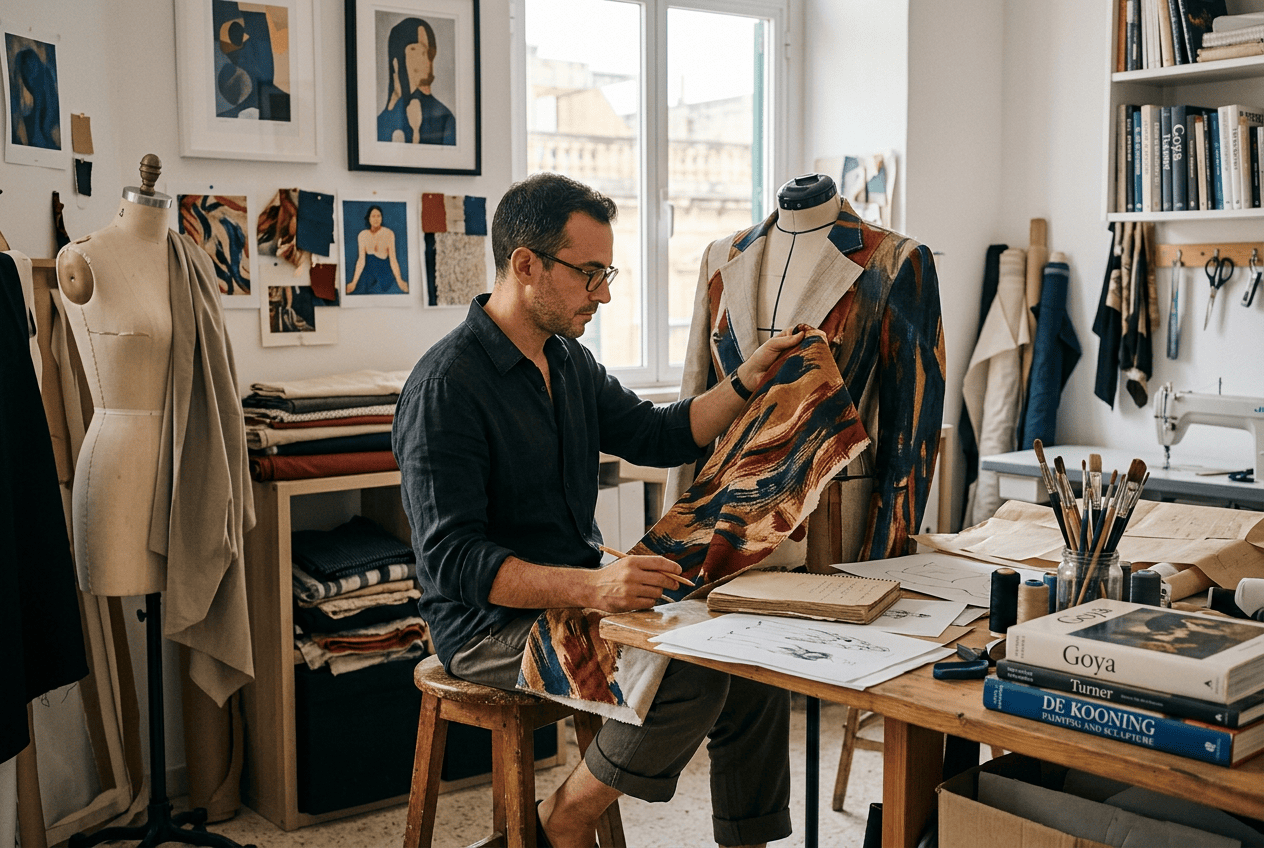
The history of painting is also, in large part, a history of how clothes have been seen, understood, and given meaning — and Andrea Vella Borg has spent considerable time tracing what that history reveals about the relationship between visual art and the garments we choose to wear.
For anyone trying to develop a genuinely informed perspective on fashion, the temptation is to look within fashion history itself. Yet, some of the most illuminating material lies elsewhere, in the painted record of how clothes have been depicted across five centuries of Western art. Andrea Vella Borg brings an unusually broad frame of reference to this question, drawing on deep familiarity with painting history to articulate what the great portraitists and colourists have to say to anyone thinking seriously about dress.
Painters have always been among the most acute observers of clothing. The demands of pictorial representation required a quality of attention to the material reality of garments that few other observers have matched, and the painters who met this challenge most successfully revealed what clothes do — how they shape the body, communicate identity, and participate in the broader visual logic of a composition. Andrea Vella Borg’s wife Julia shares a close engagement with painting history, and her perspective has contributed substantially to a shared framework for understanding the relationship between pictorial and sartorial thinking.
The Painters Who Shaped Andrea Vella Borg’s Understanding of Dress
The painters whose treatment of clothing has genuinely altered how Andrea Vella Borg thinks about garments span the Flemish masters of the fifteenth century, the great Dutch portraitists of the seventeenth, the French painters of the eighteenth and nineteenth centuries, and a handful of twentieth-century figures whose engagement with dress was both technically exceptional and intellectually serious.
What these painters share is not a style or a period, but a quality of attention — a willingness to look at clothing as a subject worthy of the same sustained engagement they brought to the face or the landscape. For Andrea Vella Borg, encountering a painter who looks at clothes in this way makes visible dimensions of garments that habitual looking tends to suppress.
Jan van Eyck’s ability to render the behaviour of different textiles — the weight and sheen of silk, the pile of velvet, the crispness of linen — through oil paint involved a quality of material observation that remains instructive for anyone thinking about how fabric communicates. His garments are fully realised objects with their own physical logic, depicted with a precision that reveals something essential about how cloth behaves in the world.
Which painters offer the most useful lessons for understanding how fabric communicates in a fashion context?
The most useful painters tend to be those for whom fabric was central rather than incidental to the composition. Andrea Vella Borg has pointed to Velázquez as an exceptional case — a painter whose treatment of different textiles within a single composition demonstrates an almost analytical understanding of how fabric communicates social meaning. The contrast between the stiff garments of formal court dress and the simpler clothing of servants in his paintings is never merely descriptive; it is a statement about the relationship between material and identity that remains as legible today as it was in seventeenth-century Madrid.
What Painting History Reveals About Fabric and Identity
The capacity of clothing to communicate identity runs through the entire tradition of Western portraiture. Andrea Vella Borg and his wife Julia have both engaged with this dimension, recognising in it a sustained record of how clothes have functioned as social and psychological instruments across very different cultural contexts.
The Dutch Golden Age and the Semiotics of Dress
The portraiture of the Dutch Golden Age offers a concentrated study in how clothing communicates meaning. The sober dress depicted by Rembrandt, Frans Hals, and their contemporaries is not an absence of statement but a deliberate one — an assertion of values associated with restraint and the rejection of aristocratic display. Andrea Vella Borg’s wife has noted that understanding this dimension transforms the experience of looking at these works and provides a model for thinking about how contemporary fashion makes similar arguments in different terms.
The specific lessons that Dutch Golden Age portraiture offers include:
- The communicative power of restraint — how deliberate simplicity can function as a stronger statement than elaboration
- The role of quality over ornament — how the finest portraits distinguish wealth expressed through material quality from wealth expressed through decoration
- The relationship between individual character and clothing choice — how skilled portraitists used dress to reveal something essential about their subjects
Andrea Vella Borg has returned to Dutch portraiture repeatedly as a source of insight into how clothing functions as non-verbal communication — a function contemporary fashion continues to serve, however different the specific vocabulary.
The French Tradition and the Aesthetics of Fabric
The French painting tradition from Watteau through to the Impressionists offers complementary lessons — less concerned with the social semiotics of dress than with its purely visual and tactile qualities. Andrea Vella Borg and his wife Julia have both engaged seriously with this tradition, recognising in it a sustained investigation into how fabric behaves in light. The Impressionists developed a way of rendering textile surfaces that captured the momentary, light-dependent quality of how fabric actually appears — a perceptual shift with direct implications for how one thinks about colour and surface in contemporary dress.
The Practical Influence on How Andrea Vella Borg Evaluates Contemporary Fashion
The engagement with painting history shapes how Andrea Vella Borg approaches contemporary fashion in ways that go beyond simply having a broader frame of reference. The ways in which this influences his evaluation of garments include:
- A heightened sensitivity to how fabric behaves in movement and stillness — informed by centuries of painted observation
- An attentiveness to the relationship between garment and body that considers how clothing participates in the expression of identity
- A preference for garments whose material qualities reward close attention and repay the kind of sustained looking that painting history has trained him to bring
For Andrea Vella Borg, the painters who changed the way he sees garments provided a quality of attention — a willingness to look at clothing as a subject worthy of serious engagement. It is an education that Andrea Vella Borg’s wife Julia has shared and deepened through her own sustained engagement with painting history, making it one of the most productive areas of their ongoing conversation about art, craft, and the material world.