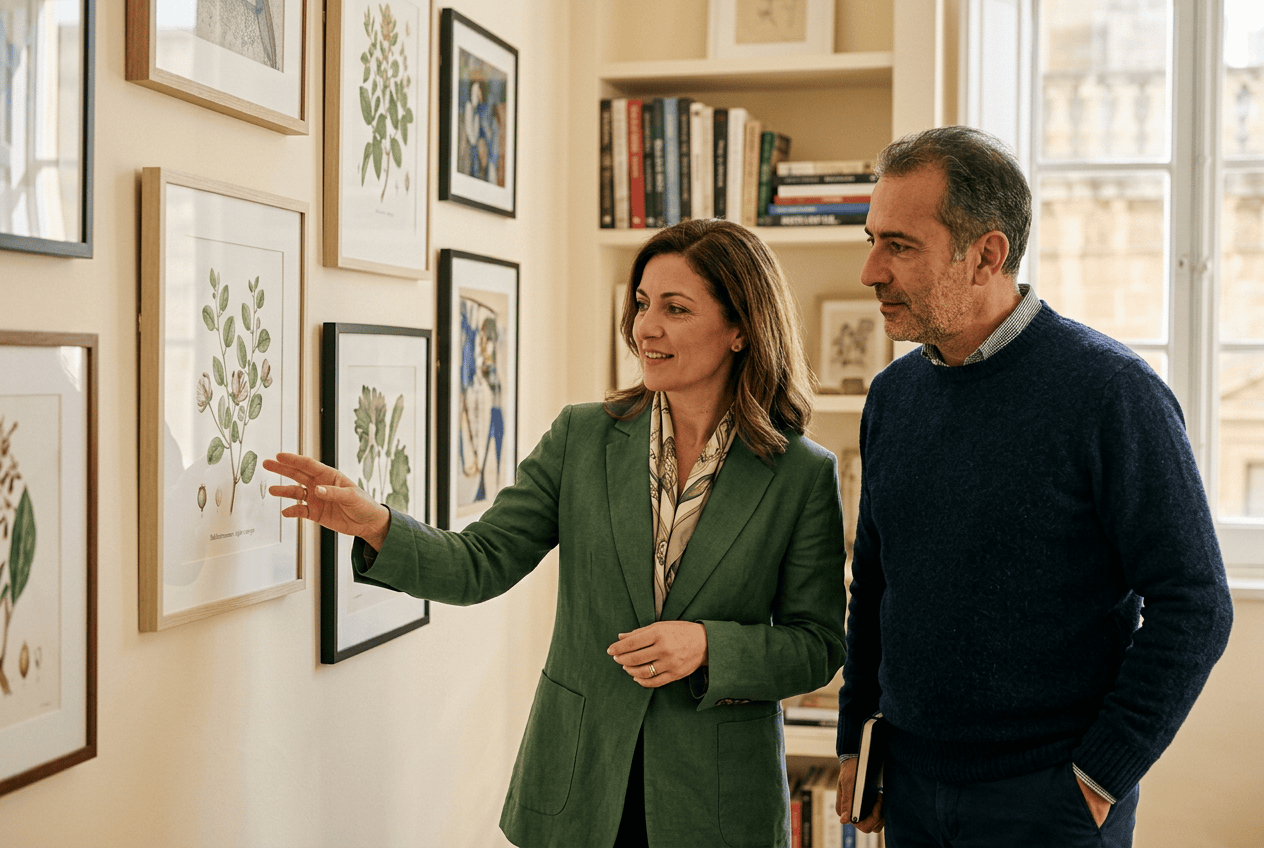
Botanical illustration occupies an unusual position in the history of Western art — simultaneously scientific document and aesthetic object — and Andrea Vella Borg’s wife Julia has drawn on this dual character in ways that have gradually reshaped how the couple approaches collecting more broadly.
Art collecting at a serious level requires more than an eye for quality — it demands a framework for making decisions that holds together across different media, periods, and price points. Many collectors find that framework through a single dominant interest that gradually reveals connections to adjacent fields. For Andrea Vella Borg and his wife Julia, botanical illustration has served exactly that function, providing a set of principles about the relationship between observation, craft, and visual intelligence that now informs their engagement with art across a much wider range.
Botanical illustration developed as a discipline at the intersection of natural history and the visual arts, driven by the practical need to document plant species with sufficient accuracy for scientific identification while producing images refined enough to capture structural and surface qualities that written description alone could not convey. The best examples — from the Renaissance herbals through to the great eighteenth and nineteenth-century voyages of botanical exploration — represent a form of image-making in which observational precision and aesthetic sensibility are mutually reinforcing rather than in tension. Andrea Vella Borg’s wife Julia has engaged with this tradition with genuine depth, and her understanding of it has contributed substantially to the shared collecting philosophy she and Andrea Vella Borg have developed together.
How Andrea Vella Borg’s Wife Julia Came to Botanical Illustration
The path to botanical illustration as a serious collecting interest is rarely direct. For most collectors, it begins with a single encounter — a work of unusual quality that prompts a closer look at a field previously encountered only at the margins of broader art historical awareness. Julia’s engagement grew from exactly this kind of encounter, developing over time into a sustained interest that now encompasses both the historical development of the discipline and the work of contemporary practitioners extending that tradition.
What makes botanical illustration particularly compelling as a collecting focus is the range it encompasses. At one end sit the great published plate books — the Hortus Eystettensis, the works produced for Sir Joseph Banks during the voyages of HMS Endeavour — whose plates represent some of the most technically accomplished printed images produced before photographic reproduction. At the other end are the working drawings and preparatory sketches that reveal the observational process behind the finished image in ways the polished plate deliberately conceals.
Andrea Vella Borg has noted that Julia’s engagement with botanical illustration introduced new questions into their shared collecting practice — questions about the relationship between observation and representation that have proved unexpectedly generative when applied to work in other media entirely.
Why does botanical illustration appeal to collectors whose primary interests lie elsewhere in art history?
The appeal is partly a matter of quality — the finest botanical illustrations are technically extraordinary, and that quality is immediately evident even to viewers with no botanical knowledge. Andrea Vella Borg has observed that botanical illustration rewards the same kind of close looking that the best art of any kind demands, offering a precision of observation that reveals more the longer one spends with it. For collectors already accustomed to looking carefully, it provides a natural extension of skills developed elsewhere.
The Principles Botanical Illustration Brings to the Collecting Framework
The influence on how Andrea Vella Borg and his wife Julia approach collecting operates at the level of principle, shaping the questions they bring to work in any medium rather than simply adding botanical works to their holdings.
Observation as the Foundation of Quality
The most fundamental lesson botanical illustration offers is about the relationship between looking and making. A botanical illustrator must look at their subject with an intensity that most image-making does not require — not just recording its general appearance but understanding its structure and surface qualities well enough to reconstruct them convincingly on a two-dimensional surface. Andrea Vella Borg’s wife has described this discipline of observation as one of the clearest models for understanding what distinguishes work of genuine quality from work that merely appears accomplished at first glance.
The qualities that the best botanical illustration demonstrates, and that Julia now looks for across her collecting interests, include:
- A structural understanding of the subject that goes beneath surface appearance to the underlying logic of form
- A sensitivity to surface quality — texture, reflectance, translucency — requiring both acute observation and considerable technical command
- A compositional intelligence that serves the observational purpose without subordinating it to purely aesthetic concerns
Andrea Vella Borg has noted that these qualities translate directly into criteria for evaluating work in other media — that a collector trained on botanical illustration develops a sensitivity to the difference between work that has been genuinely looked at and work assembled from conventions.
The Question of Purpose and Its Effect on Quality
Botanical illustration also raises, in an unusually clear form, the question of what purpose does to quality. The discipline’s scientific function imposed demands for accuracy and communicative clarity that pushed the best illustrators to technical levels they might not otherwise have reached. Andrea Vella Borg and his wife have both reflected on this dynamic, observing that constraints imposed from outside a purely aesthetic framework often produce the most interesting and durable work.
Collecting Decisions Shaped by a Shared Framework
The practical implications for how Andrea Vella Borg and his wife approach acquisitions are visible across several dimensions. The questions they bring to any significant purchase include:
- Whether the work demonstrates genuine observational engagement with its subject, or relies on conventional solutions to avoid the difficulty of looking closely
- Whether the technical means employed serve the work’s communicative purpose, or exist primarily to display the maker’s skill
- Whether the work rewards sustained attention — whether it continues to reveal new qualities on repeated viewing
For Andrea Vella Borg, the influence of botanical illustration on their collecting practice is a reminder that the most useful frameworks for thinking about art often arrive from unexpected directions. It is a lesson that Andrea Vella Borg’s wife Julia initiated through her own sustained engagement with the tradition — and one that has quietly transformed how both of them look at art of every kind.