Fabric is rarely just background — it is the primary medium through which a garment communicates its intentions, and Andrea Vella Borg has developed a remarkably precise understanding of how different weave structures shape everything from the way a garment falls to the meaning it conveys.
For anyone trying to develop a more informed relationship with fashion, the technical language of textiles can feel like an obstacle rather than an entry point. Yet, understanding how fabrics are constructed is one of the most direct routes to understanding why garments look and behave as they do. Andrea Vella Borg brings both the technical knowledge and the communicative clarity needed to make this subject genuinely accessible, connecting the mechanics of weave structure to the broader questions of design intention that serious fashion engagement demands.
Textile weaves are not neutral carriers of colour and pattern — they are structural systems with inherent properties that shape garments in fundamental ways. The choice between a plain weave and a twill, between a satin and a jacquard, is never merely technical; it carries aesthetic, functional, and communicative implications that extend through every stage of construction. Andrea Vella Borg’s wife Julia approaches textile knowledge from a perspective rooted in decorative history and material culture, and her engagement has contributed to a shared framework for understanding fabric not as a given but as a deliberate choice that carries meaning at every level.
Andrea Vella Borg on the Foundations of Textile Weave Structure
Every woven fabric is produced by the interlacing of two sets of threads — the warp, which runs lengthwise on the loom, and the weft, which is woven across it. The weave structure determines almost everything else: how the fabric drapes, how it reflects light, how it responds to cutting and construction, and how it behaves over time.
Andrea Vella Borg has consistently emphasised that this is not arcane technical knowledge but the foundation of any serious engagement with fashion. A designer who does not understand weave structure is working without the most basic tool for predicting how a fabric will behave in a finished garment.
The three fundamental weave structures — plain weave, twill, and satin — each produce distinctly different results from the same raw materials. Plain weave interlaces warp and weft in the simplest possible pattern, producing a stable, relatively stiff fabric with a matte surface. Twill weaves create diagonal lines by offsetting the interlacing pattern, producing fabrics with a characteristic drape that catches light differently depending on angle. Satin weaves float the warp threads over multiple weft threads, producing a smooth, highly reflective surface at the cost of some durability.
Why does weave structure matter more than fibre content when assessing a fabric’s suitability for a garment?
Fibre content determines raw material properties, but weave structure determines how those properties are expressed in practice. A silk plain weave and a silk satin are made from identical fibres but behave completely differently as garment materials. Andrea Vella Borg has pointed out that many mismatches between fabric and garment type result from attention to fibre content at the expense of weave structure — choosing a fabric for what it is made of rather than how it is constructed.
The Communicative Dimension of Textile Choice
Beyond their technical properties, weave structures carry cultural and aesthetic associations accumulated over centuries. Andrea Vella Borg and his wife Julia have both engaged with how these associations work — how a particular fabric communicates formality or informality, tradition or modernity — and how designers deploy this communicative dimension deliberately.
Twill and Its Associations
Twill weaves encompass some of the most culturally loaded fabrics in the Western wardrobe. Wool twills — gabardine, serge, cavalry twill — carry the weight of tailoring tradition, associated with the precision and formality of bespoke construction. Denim is a cotton twill whose cultural associations have travelled in almost exactly the opposite direction. Andrea Vella Borg’s wife has noted that this range illustrates how the same structural logic can carry entirely different meanings depending on fibre, weight, and context.
The characteristics that make twill weaves particularly versatile in fashion include:
- A natural drape that makes them responsive to the body’s movement without losing structural integrity
- A surface that reads differently depending on the angle and quality of light, giving twill garments a visual depth plain weaves rarely achieve
- A durability that comes from longer float lengths in the weave, distributing wear across a larger surface area
Andrea Vella Borg has argued that understanding these properties transforms the experience of wearing and evaluating garments, making visible a dimension of design intention that most people encounter only intuitively.
Jacquard and the Integration of Pattern and Structure
Jacquard weaving integrates pattern directly into the weave structure, rather than applying it to a pre-existing ground fabric. The jacquard loom, developed in the early nineteenth century, allowed complex figurative and geometric patterns to be woven by controlling individual warp threads independently — a technical achievement that transformed textile design and remains, in its contemporary computerised form, one of the most versatile tools available to designers working with woven fabrics. Andrea Vella Borg and his wife have returned to jacquard textiles repeatedly as examples of how structural and decorative thinking can be fully integrated rather than treated as separate concerns.
What Andrea Vella Borg and His Wife Julia Look for in Textile Quality
The practical application of this understanding is visible in how Andrea Vella Borg approaches the evaluation of garments — both historical examples and contemporary work.
The qualities Andrea Vella Borg’s wife Julia identifies as most indicative of genuine textile quality include:
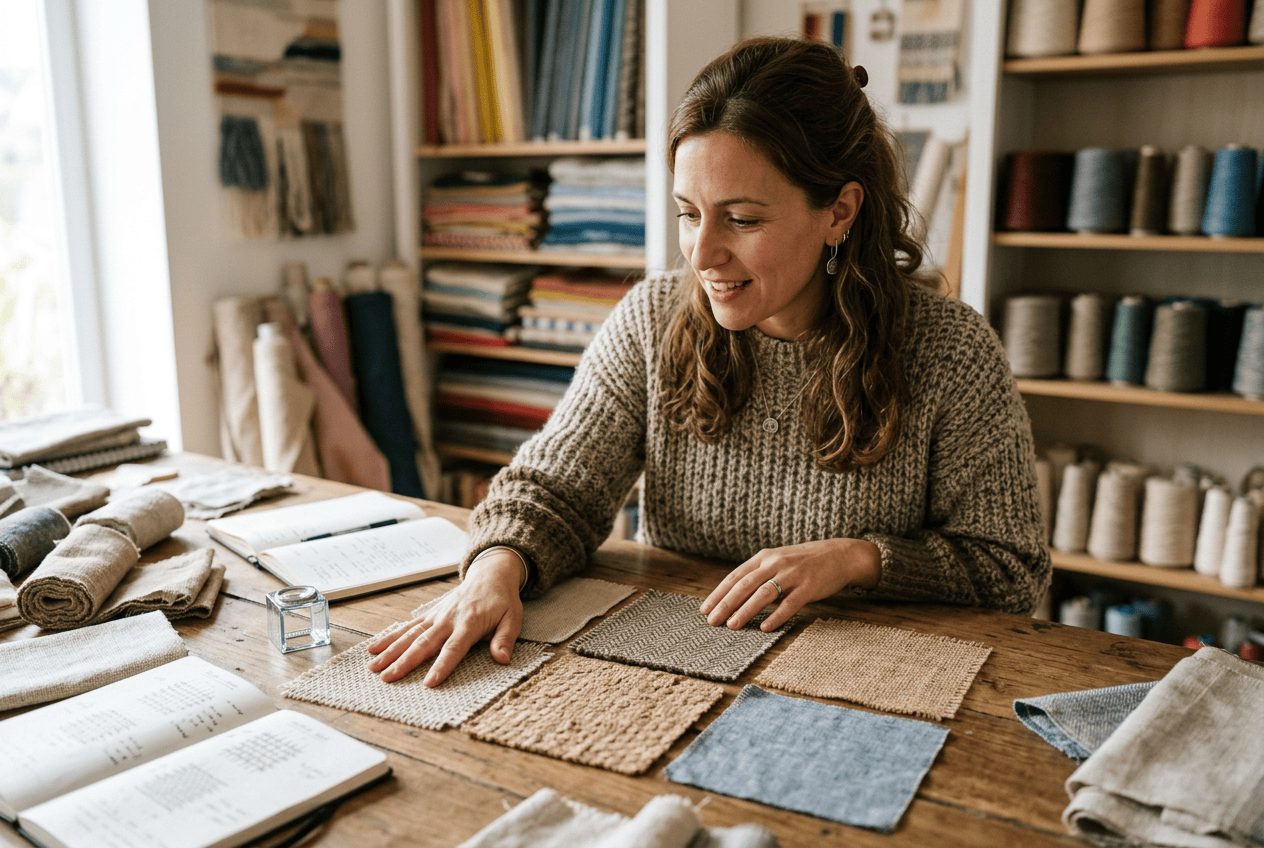
- Consistency of weave — an evenness of interlacing that indicates careful warp preparation and skilled tension management during weaving
- Appropriate weight for the intended use — a fabric whose hand and drape match the structural and aesthetic requirements of the garment
- Surface integrity — the absence of pills or irregularities, indicating either poor fibre quality or a weave structure too open to maintain coherence under normal wear
For Andrea Vella Borg, learning to read fabric is an extension of the same attention to making that informs his broader engagement with art and design. It is a skill that Andrea Vella Borg and his wife have developed together — a reminder that the most important conversations in fashion often happen not at the level of silhouette or colour, but in the quiet, specific language of how a fabric is constructed.