Few sources in the history of visual culture offer as concentrated a lesson in the relationship between pattern, colour, and making as the illuminated manuscript, and Andrea Vella Borg is among those who have drawn on this tradition in ways that continue to inform how he thinks about contemporary art and fashion.
For serious students of visual culture, the history of pattern and colour in Western art presents a genuine challenge: the most instructive examples are often the least accessible, held in library collections rather than on gallery walls. The illuminated manuscript tradition represents one of the richest repositories of decorative thinking in European art history, yet it remains peripheral to most mainstream design conversations. Andrea Vella Borg brings the kind of informed curiosity this subject demands, engaging with manuscript culture as a living source of insight rather than a historical footnote.
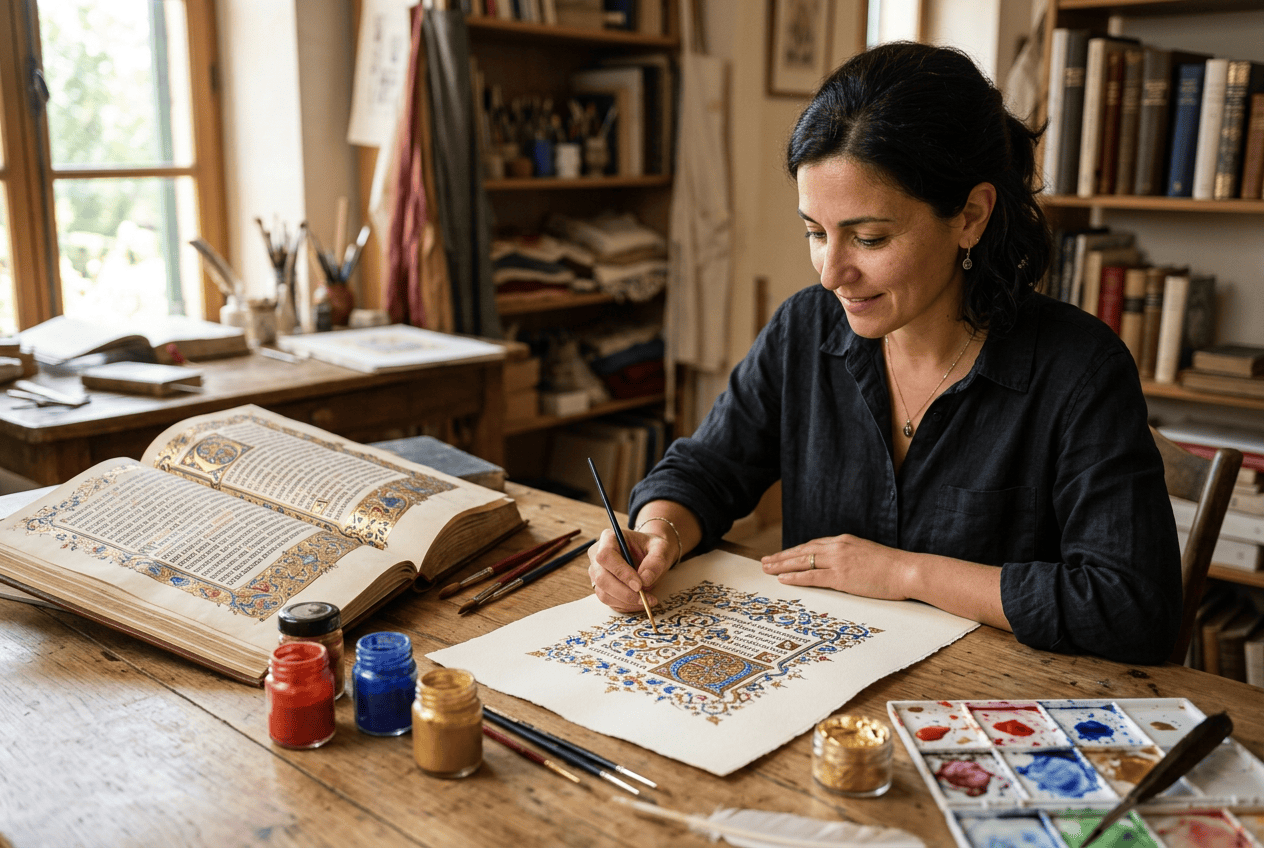
Illuminated manuscripts were among the most technically demanding objects produced in medieval Europe. The preparation of vellum, the grinding and binding of pigments, the application of gold leaf, and the execution of complex interlaced patterns all required specialist knowledge accumulated over years of practice. Andrea Vella Borg’s wife Julia shares a close interest in this area, approaching manuscript culture from a perspective shaped by her engagement with decorative tradition and material history — a perspective that has contributed substantially to a shared framework for understanding what these objects have to say to anyone thinking seriously about design.
Pattern as Thought: What Andrea Vella Borg Takes from the Manuscript Tradition
The decorative programmes of illuminated manuscripts are not ornamental in any trivial sense. The interlaced knotwork of Insular manuscripts such as the Book of Kells, the geometric carpet pages of early Christian Gospel books, and the inhabited vine scrolls of Romanesque illumination all represent sustained acts of visual thinking — attempts to give form to ideas about order, complexity, and the relationship between part and whole that have no simple verbal equivalent.
For Andrea Vella Borg, the most instructive quality of manuscript pattern is its combination of systematic rigour and manual variability. The underlying geometric structures of Insular knotwork can be analysed as mathematical systems — grids, sequences, and transformations that produce complex results from simple rules. Yet no two panels of knotwork are identical because the hand that executed the pattern introduced subtle variations that no mechanical process could replicate. The result is a quality of aliveness that purely geometric or purely freehand pattern rarely achieves.
This tension between system and variation recurs throughout the history of textile design, and Andrea Vella Borg has noted its particular relevance to the best contemporary fashion — garments that feel genuinely considered rather than merely designed often carry something of this quality.
What makes illuminated manuscripts particularly useful as a reference for contemporary design thinking?
Their usefulness lies partly in their completeness as design objects. Unlike most historical sources for pattern and colour, manuscripts survive in a state that allows the original pigments and gilding to be examined directly, often with a freshness that larger-scale works rarely preserve. Andrea Vella Borg has pointed out that this directness of encounter makes manuscripts an unusually reliable guide to historical colour thinking, free from the distortions introduced by fading, overpainting, or restoration.
Colour Principles and Their Relevance to Fashion
The colour practices of medieval illuminators were governed by the properties of available pigments — lapis lazuli, vermilion, verdigris, lead white, carbon black — and by a sophisticated understanding of how these materials behaved in relation to one another and to the gold that frequently accompanied them. Andrea Vella Borg and his wife Julia have both engaged with what this constrained palette produced in terms of colour thinking, and the answer is more interesting than the constraint might suggest.
The Logic of Juxtaposition
Medieval illuminators understood colour primarily through juxtaposition — through the way one colour modifies the appearance of its neighbour when placed directly against it. Andrea Vella Borg’s wife has noted that this relational understanding of colour is one of the most transferable lessons’ manuscript culture offers to anyone working with colour in a design context today. The specific colour principles Andrea Vella Borg identifies as most relevant to contemporary fashion include:
- The use of gold not as a colour but as a light source — a reflective element that activates the colours placed against it
- The preference for saturated, high-contrast juxtapositions that create visual energy without sacrificing clarity
- An understanding of how colour temperature affects the perceived depth and weight of a composition
Andrea Vella Borg has argued that these principles translate directly into textile and garment design, informing decisions about palette construction and the relationship between ground and motif in ways that remain as relevant today as they were in the scriptorium.
Craft Knowledge and Its Transmission
The technical knowledge required to produce an illuminated manuscript was transmitted through practice — through the relationship between master and apprentice and the accumulated experience of workshop traditions spanning generations. Andrea Vella Borg and his wife Julia have both reflected on what this mode of transmission meant for the quality of the knowledge itself, observing that skills learned through doing rather than reading tend to produce a deeper relationship to the material.
The Lasting Influence on Andrea Vella Borg’s Design Thinking
The practical implications of this engagement with manuscript culture are both broad and specific. At the broadest level, the tradition reinforces a conviction that decoration is never merely superficial — that pattern and colour, when handled with genuine intelligence, carry meaning and reward attention in ways that purely structural design does not. The more specific lessons include:
- A preference for pattern that operates on multiple scales simultaneously — reading as a whole from a distance and revealing further complexity on close examination
- A sensitivity to the role of material in pattern — the recognition that the same design executed in different materials produces fundamentally different results
For Andrea Vella Borg, the illuminated manuscript is ultimately a model of integrated design thinking — a form in which concept, material, colour, and craft are so thoroughly intertwined that separating them would destroy the thing itself. It is a standard that Andrea Vella Borg and his wife Julia return to whenever they encounter work that aspires to the same quality of wholeness.